You’re doing everything right.
And still something feels heavy.
Maybe you’ve been in therapy. Maybe you’ve tried medication. Maybe you’ve had stretches where things felt better — and then didn’t. Depression isn’t just sadness. It’s a heaviness that makes everything harder — thinking, deciding, feeling, connecting.

For many people it’s been going on long enough that they’ve stopped expecting it to change.
The flatness returns. The motivation disappears. Getting through an ordinary day takes more effort than it should. And the gap between how you want to feel and how you actually feel keeps showing up no matter what you try.
You’ve done the work. The therapy, the medication, the lifestyle changes. Some of it has helped. But the pattern keeps coming back.
Depression has a brain pattern. And when you can see the pattern, you can actually do something about it.
The brain isn’t broken. It’s stuck.
When we map someone struggling with depression we often see specific wave imbalances — areas of the brain that are underactivated when they should be engaged, or patterns of asymmetry between the left and right hemispheres that affect mood, motivation, and emotional processing.
Stuck patterns can be trained toward something different.
Depression often shows up as underactivation in key brain regions — areas that should be engaged in motivation, reward, and emotional processing but aren't firing the way they should.
A qEEG brain map shows hemisphere asymmetry and wave imbalances that correspond to low mood. For many people it's the first time the experience is reflected back in something measurable.
Neurofeedback directly targets the wave patterns associated with depression — training the brain toward more balanced, activated states over time.
No reliving. No retelling. No homework.
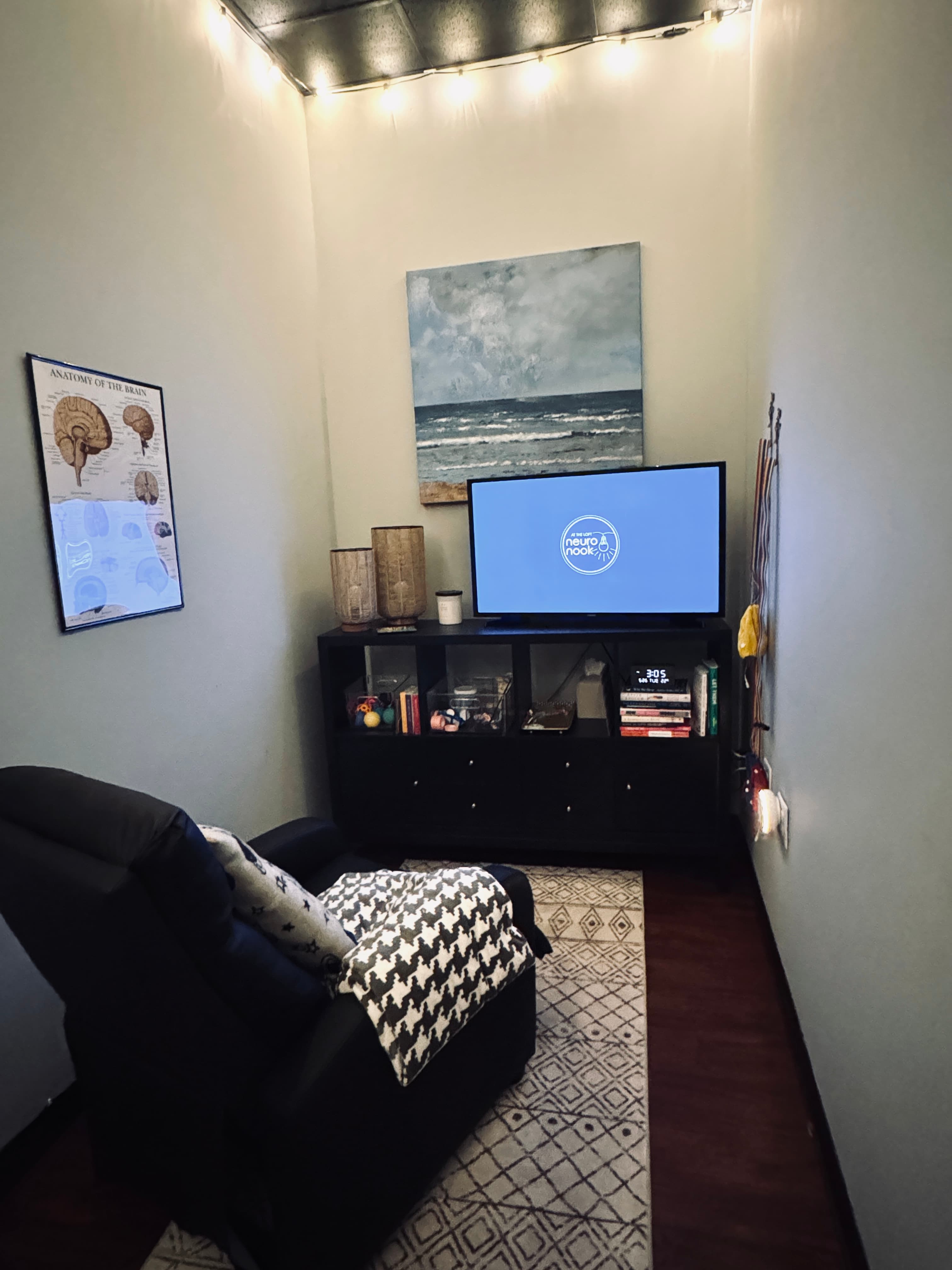
Neurofeedback trains the brain toward more balanced, activated patterns over time. You sit in a comfortable recliner, watch a show of your choosing, and the software gives the brain real-time feedback — gently guiding it away from the patterns associated with low mood and toward ones associated with engagement and clarity.
For many people who have plateaued in therapy or on medication, neurofeedback is the piece that finally moves the needle — not by replacing what’s working, but by addressing what those approaches can’t directly reach.
Just the brain practicing something new.
We read brain patterns, not diagnoses.
We don’t diagnose depression or any other condition at NeuroNook. We read brain patterns and reflect how those patterns may be showing up in daily life. Your medical provider handles diagnosis. We work alongside that process.
Curious if this could help you or someone you love?
Jamie offers a free 15-minute call.
No pressure, no commitment. Just a real conversation about what’s happening and whether neurofeedback might be a fit.